

- 14th August 2026
- 4 mins min read
Workplace Design Trends Shaping the Middle East
Discover how leading organisations in the UAE and Saudi Arabia are using flexible workplaces, employee wellbeing, smart technology, and sustainable design to drive growth and attract talent.
Noura Khater
Design Lead, Middle East
The Changing Face of Workplace Design in the Middle East
Office space across the Middle East has moved faster in the last three years than in the decade before it. Where organisations once came to us chasing a certain look and feel, they now arrive asking a sharper question: what should this space actually do for our people and our business?
That shift shows up everywhere. Employees expect real choice over where and how they work. Quiet rooms sit alongside collaboration spaces as standard, not as an afterthought. And the workplace aesthetic itself is borrowing more from hospitality than from traditional corporate design. A well-executed workplace strategy bridges organizational goals with employee experience. A few years ago, we were the ones explaining these ideas to clients. Now, many clients arrive already asking for them.
This article explores the trends shaping workplaces across the UAE, Saudi Arabia and the wider region – flexible, activity-based working; wellbeing-led design; smart, data-driven planning; and sustainability that’s no longer optional but expected. It also looks at what these trends mean for the future of workplace design in the Middle East, and how organisations can prepare to move with it.
Why workplace strategy is moving from support function to growth driver
From cost centre to strategic advantage
Office fit-out used to be treated as an operational line item – something to manage, not invest in. That thinking has all but disappeared. Workplace strategy now sits in the same conversations as growth, brand and culture.
Some organisations arrive with a clear brand guideline or global HQ standard the workplace needs to reflect. Others are still shaping their identity, and use the design process itself to help define it, meaning the workplace and brand sometimes get built in parallel, from the ground up. Either way, growth is almost always part of the brief. Many clients are already thinking about expansion, so flexibility has to be designed in from day one, not retrofitted later.
The office design trends shaping workplaces across the region; flexible, activity-based working
Designing for hybrid, not just accommodating it
Hybrid working is reshaping how much space organisations in the Middle East actually need, much as it has in Europe and the US. Rather than fixed workstations for every employee, many organisations are moving to desk-sharing ratios that reflect real attendance patterns instead of headcount on paper.
This is proving especially valuable for organisations in sectors like telecoms and real estate, where teams don’t need a desk for every employee every day, but do need a space that works for how the business actually operates. In some projects, this is supported by digital booking platforms that let employees reserve a desk for a set number of hours enabling several people to move through the same workstation across a single day.
Spaces that flex as teams evolve
Flexibility isn’t only about desk ratios, it’s about a layout that can adapt as a business grows or its needs shift. That might mean a meeting room designed to convert into a smaller huddle space, or zones built to be repurposed as headcount changes. Designing this adaptability in from the start avoids costly redesign later, and gives organisations room to grow without losing the coherence of their original workplace strategy.
Wellbeing at the centre of design
Light, nature and biophilic design
Wellbeing has moved from nice-to-have to expected baseline. Considered environments including dedicated mothers’ rooms and prayer rooms are no longer optional extras in the region; they’re simply expected. Sustainability sits right alongside this, with planting, natural light and air quality treated as fundamental to a brief rather than finishing touches added at the end.
Acoustics, air quality and focus areas
Designing for wellbeing here brings challenges that don’t always apply elsewhere, largely down to climate. Heat generated by equipment such as air conditioning and fan coil units has to be factored into space planning from the outset, alongside the ambient temperature of the region itself. High-output LED lighting and heavily glazed buildings can add to that heat load, but solutions like exterior glazing film which filters the volume of heat entering a space now make it possible to manage comfort without scaling back on what a business wants from its design. The unseen elements of a workplace including air quality, thermal comfort and energy performance matter just as much as anything visible in the finished space.
Smart workplaces in motion
Data-led space planning
Great workplace design starts long before the layout is drawn. A detailed brief, or, where a client doesn’t have one, a structured discovery process and due-diligence review shapes the eventual outcome far more than any single design choice. The more we understand about a business’s culture, people and goals up front, the more aligned and personalised the workplace strategy that follows.
Where AI and automation are adding real value
AI is one of the most talked-about tools in workplace design right now, but its value depends entirely on how it’s used. Paired with specialist human knowledge and judgement, it can genuinely speed up parts of the design process. Used on its own, it can create more problems than it solves; an AI-generated adaptation of a design can miss critical physical constraints, like structural columns, that only trained human judgement and experience reliably catches. The clearest lesson from the region so far: technology supports good workplace strategy. It doesn’t replace it.
Sustainable workplace design
Materials, certifications and circular thinking
Sustainability in a Middle East workplace context spans several dimensions: environmental performance, waste management, lighting and energy efficiency, and air quality, alongside materials and furniture chosen with reuse in mind – an increasingly important consideration for organisations that may relocate or expand into additional space in future. Recognised accreditations like WELL, Fitwel and LEED are becoming a standard reference point for organisations benchmarking their workplace against global best practice.
Designing for the climate, not against it
Sustainability commitments in the region aren’t driven solely by ESG reporting or investor pressure, though both are real factors. Increasingly, sustainability is built into a building’s requirements from the earliest stages of development, rather than bolted on further down the line meaning workplace designers now work within a sustainability framework by default.
How leading organisations are putting these trends into practice
Examples from the UAE and Saudi Arabia
The UAE remains a mature, fast-moving market for workplace design, but Saudi Arabia is emerging as one of the most exciting opportunities in the region. Its market is expanding quickly, opening the door for workplace strategists to help shape culture there from the ground up combining global best practice with everything already learned in Dubai’s more established market.
What different sectors are prioritising
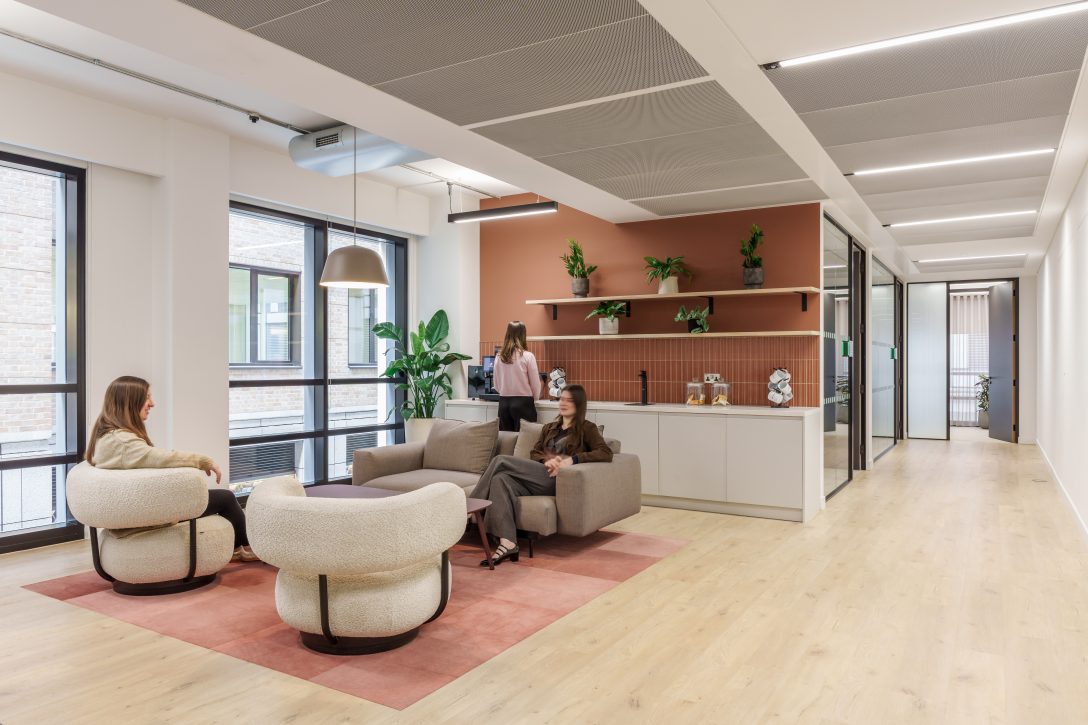
Different sectors are putting these trends to work in different ways. Telecoms and real estate organisations are leaning into desk-sharing models to manage space efficiently against fluctuating attendance. Multinational consumer businesses, as seen in the global FMCG group’s treasury centres project, are prioritising a wide range of functional zones from quiet rooms to flexible meeting spaces within a compact footprint, guided by strict workplace guidelines.
What’s next for workplace design in the Middle East?
Preparing for changing workforce expectations
Looking three to five years ahead, a future-ready workplace in this region centres on comfort in the broadest sense, not lavish, hospitality-style finishes for their own sake, but spaces built around how much time people spend at work and what makes that time worth showing up for. Getting this right tends to show up in better use of office space, stronger productivity, and higher day-to-day satisfaction.
Balancing global best practice with regional context
The organisations getting the most from their workplace strategy tend to treat their design partner as a long-term collaborator, not a one-off contractor. That means support that continues well beyond project completion from early test fits before a space is even secured, through to adjustments long after move-in. Aligning on budget and timeline early keeps a project on track, and flagging products with long lead times up front avoids delays and disappointment later.
Built for what’s next: How AIS can support your business
The organisations shaping the future of workplace design across the Middle East are the ones treating their office as a strategic asset built to flex, support wellbeing, and grow alongside the business.
We create space for growth: not just the physical environments we design, but the opportunity and breathing room organisations need to move forward with confidence. That’s what being Built for Momentum means in practice; workplaces that perform today and adapt for whatever comes next.
We work with organisations across the UAE and Saudi Arabia to turn that thinking into workplaces that deliver, from early test fits and due diligence through to design, delivery and beyond. If you’re planning a workplace project and want a partner who understands both global best practice and the realities of designing for this region, explore AIS’s workplace strategy and design expertise.
Frequently Asked Questions
What are the biggest workplace design trends shaping the Middle East right now?
Flexible, activity-based working; wellbeing-focused design including biophilic elements and dedicated quiet or prayer spaces; smart, data-led space planning; and sustainability built in from the earliest stages of a project.
How is sustainability changing office design across the UAE?
Sustainability is increasingly a requirement rather than a choice, factored in from a building’s initial development through material selection, waste management, energy use and air quality, and benchmarked against accreditations like WELL, Fitwel and LEED.
What makes a workplace "smart," and what does it actually do for a business?
A smart workplace uses data gathered through detailed briefs, discovery and space-usage insight to inform design decisions before a project even begins, and may use technology like desk-booking platforms to manage flexible working. Used well alongside specialist expertise, tools like AI can support this process, though they can’t replace it.
Why does employee wellbeing matter so much in office design today?
Wellbeing-focused environments have become an expectation, not a bonus. In the Middle East, that includes climate-specific considerations like managing heat from equipment and glazing, alongside universal elements like natural light, air quality and dedicated quiet spaces.
What does it take to build a workplace that's ready for what's next?
A workplace designed with flexibility built in, shaped by a real understanding of a business’s culture and goals, and backed by a design partner offering continuous support rather than a single, fixed deliverable.
Does hybrid working really reduce the need for office space?
For many organisations, yes. Desk-sharing ratios and booking systems let businesses provide a workplace suited to actual attendance patterns rather than total headcount, an approach proving particularly effective in sectors like telecoms and real estate.