How Financial Services Workplaces Are Evolving Beyond Traditional Offices
Find out how financial services workplaces are evolving beyond traditional office design, embracing hybrid working, flexible workspaces and employee wellbeing.
How Financial Services Workplaces Are Evolving Beyond Traditional Offices
For decades, the financial services office followed a familiar script: rows of desks, a boardroom at the centre, a hierarchy built straight into the floor plan. That script is being rewritten. Banks, fintechs and financial institutions are asking harder, more interesting questions about what an office is actually for, and the answers are moving fast.
This isn’t about adding a few breakout sofas or a coffee machine that grinds its own beans. It’s a genuine shift in how success is measured, from how many desks a space holds to what it helps people do, feel and achieve once they’re in it. For a sector once defined by caution and convention, that’s a bold move. And it’s opening up real space for growth.
From occupancy to purpose and experience
The clearest shift we’ve seen in financial services workplace design over the last two to three years is a move away from occupancy-led thinking and towards purpose and experience.
Office design used to be a numbers exercise: headcount, desk count, square footage. Today, the first question is different. What is this space for, and what should it feel like to use it?
Fintech clients are pushing this shift harder. They arrive knowing their brand inside out, and with the fundamentals around acoustics, furniture and technical performance expected to meet the brief, the conversation can move quickly into how the space will be used and how it will set the business apart. The brief starts smarter and moves faster.
Part of this comes down to expectation. People have grown up surrounded by beautifully designed digital products and physical spaces, and social media puts that standard in front of them constantly. A well-considered office isn’t a bonus anymore, it’sthe baseline. That same energy is rippling through the tech sector too, where employees take real pride in the brand, culture and space they work within.
Beyond hybrid: the financial services office plays a much bigger role
Financial services have traditionally been more office-bound than most sectors; security and compliance made sure of that. But hybrid working has changed the brief in ways that go well beyond hot-desking.
For global financial and fintech organisations, hybrid now means working across time zones and borders, not simply switching between home and one office. The London headquarters isn’t automatically the right place for every task; work happens wherever it makes the most sense, with security and compliance considerations built in from the outset, given what’s at stake in banking data.
There is no single model. Some businesses want the workplace to support a broader overlap between work and everyday life, while others simply want a practical, high-performing office for the working week. It depends entirely on the personality, culture and expectations of the business, and the design should respond accordingly.
What “flexible workspace” really means now
Flexible workspace solutions in financial services used to mean things like movable walls, the ability to make a room bigger or smaller on demand. That’s no longer the full picture.
Our fintech clients have pushed us to think about flexibility in terms of purpose, not square footage. A single event space might need to flex from keynote to awards ceremony to cinema screening, sometimes within the same week. The question isn’t”can we make this room bigger”, it’s “can this room become whatever the business needs it to be, seamlessly.”
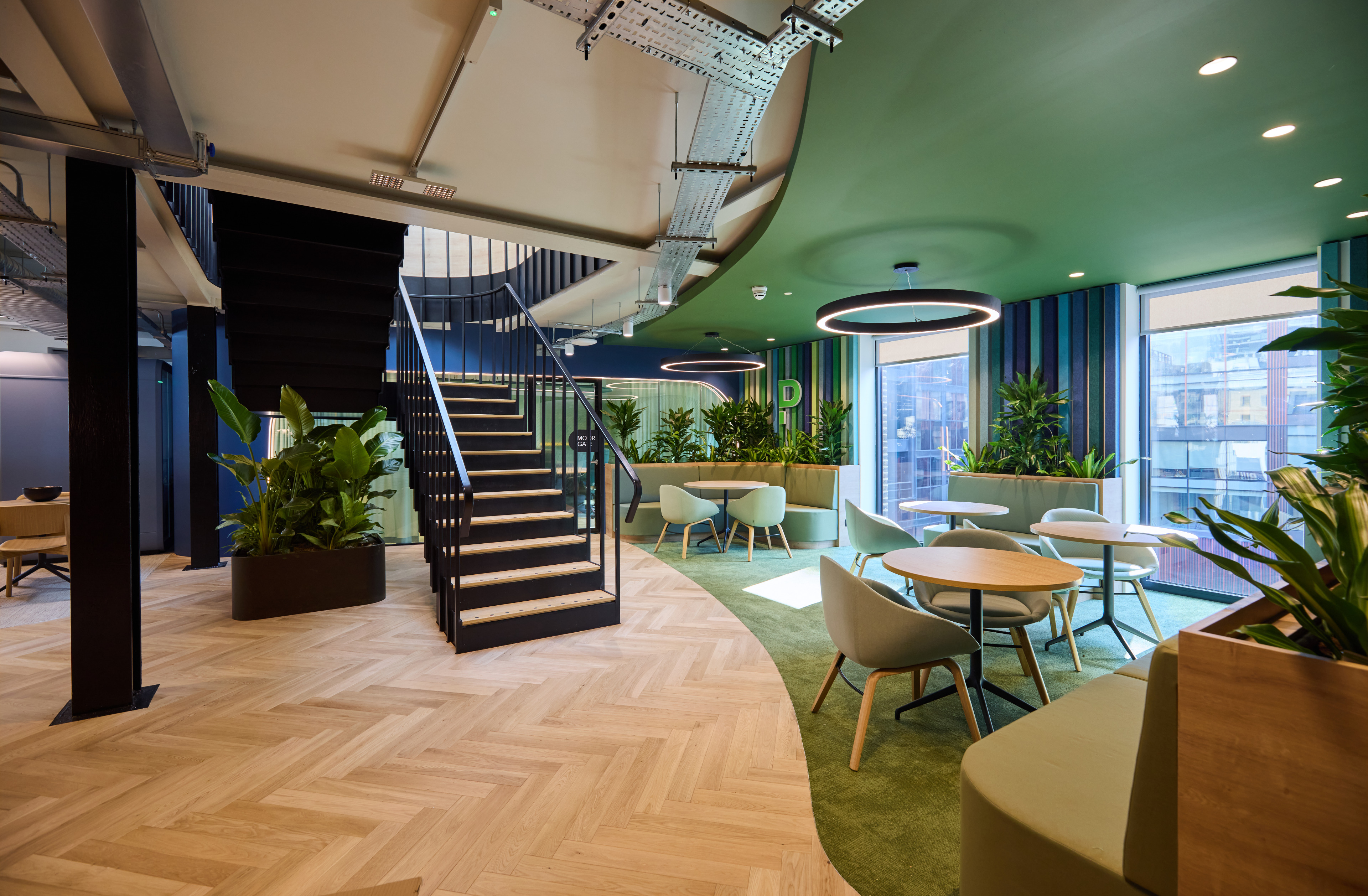
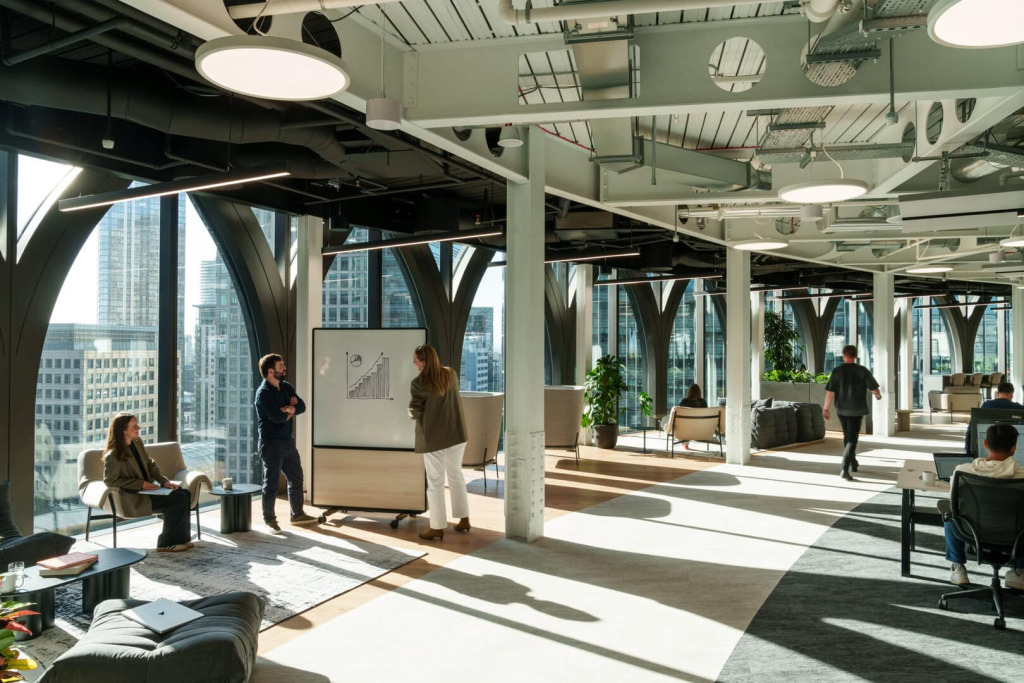
In many modern workplace schemes, individual desk-based work now occupies only part of the floor plan; the rest supports collaboration, events, wellbeing and the wider needs of the business.
Wellbeing has moved to the heart of the workplace
One of the clearest signs of how far financial services workplace design has evolved is where wellbeing spaces now sit within the building.
It used to be common to tuck wellbeing facilities into a basement or a spare box room, an afterthought. That’s reversed. Quiet rooms, prayer rooms, spaces for new parents; these now claim some of the best positions in the building, often the spot once reserved for a boardroom that, with meetings increasingly virtual, no longer needs to dominate the plan.
There’s real intent behind this, too. Rather than grouping every wellbeing facility into one dedicated suite, we favour weaving these spaces throughout the workplace, so using them never singles anyone out. Integrating wellbeing into the everyday fabric of the office, instead of isolating it, removes the stigma that so often surrounds it. It’s a small design decision that sends a clear signal: this organisation trusts its people. And that trust matters, because employees who feel genuinely supported are better equipped to perform when the pressure is on.
Balancing flexibility with security and compliance
Open, collaborative design and strict regulatory requirements might sound like they pull in opposite directions. In financial services, the two have to move together from day one.
Security and compliance aren’t bolted on at the end; they’re built into the brief from the start. Financial institutions know their regulatory obligations better than anyone, and that expertise gives us a strong foundation to build on. The most effective approach is to identify and resolve the sensitive spaces early, secure meeting rooms, confidential client areas, data-sensitive zones, so the rest of the design can open up around them with real freedom. Get the crucial spaces right first, and everything else moves faster.
Workplace design as a talent strategy
Financial services firms aren’t just competing with each other for talent. They’re competing with tech, and workplace design has become part of how they win.
The strongest brands don’t just attract employees; they create genuine believers. Think about the communities that surround iconic brands or personalities whether it’s ‘Swifties’, ‘Beliebers’ or the loyal following behind brands like Apple or Patagonia. The same dynamic is increasingly visible inside leading fintech and financial services organisations. When people genuinely connect with a company’s purpose, culture and identity, they become advocates for the brand, proudly recommending it to friends, potential recruits and clients alike. The workplace has an important role to play in reinforcing that sense of belonging and pride.
For fintech brands especially, employee loyalty can look a lot like fandom: people want to work for the brand, not just the role, and they want that pride reflected in the space around them. That means designers must immerse themselves fully in a client’s culture to keep pace, and the payoff is a workplace people feel genuinely proud to be part of.
Formal, sector-wide data linking workplace design to retention is still an emerging area; this is new ground, and it’s moving quickly. But tools like the Leesman Index are already helping benchmark and validate design decisions on live projects, giving clients real evidence for what a well-designed meeting room or breakout space needs to deliver.
Practical steps to modernise a financial services workplace
For any financial services organisation ready to modernise its workplace, the starting point isn’t the desk. It’s the people.
Understanding how different teams work, engineers versus creatives, quiet-focus roles versus highly collaborative ones, matters more than adding more desks ever will. That means paying attention to footfall, protecting space for different working styles, including neurodiverse ways of working, and designing with intention rather than ticking boxes.
It’s worth asking a more human question too: why would someone choose your office over working from home, or over a competitor down the road? With admin, personal life and work life increasingly blending into one, giving people a genuine reason, and a good experience, once they arrive matters more than ever.
Looking ahead
Financial services workplace design has already moved through several major shifts, the pandemic, the rise of agile working, and hybrid as the new standard. What comes next may be less about reinvention and more about refinement.
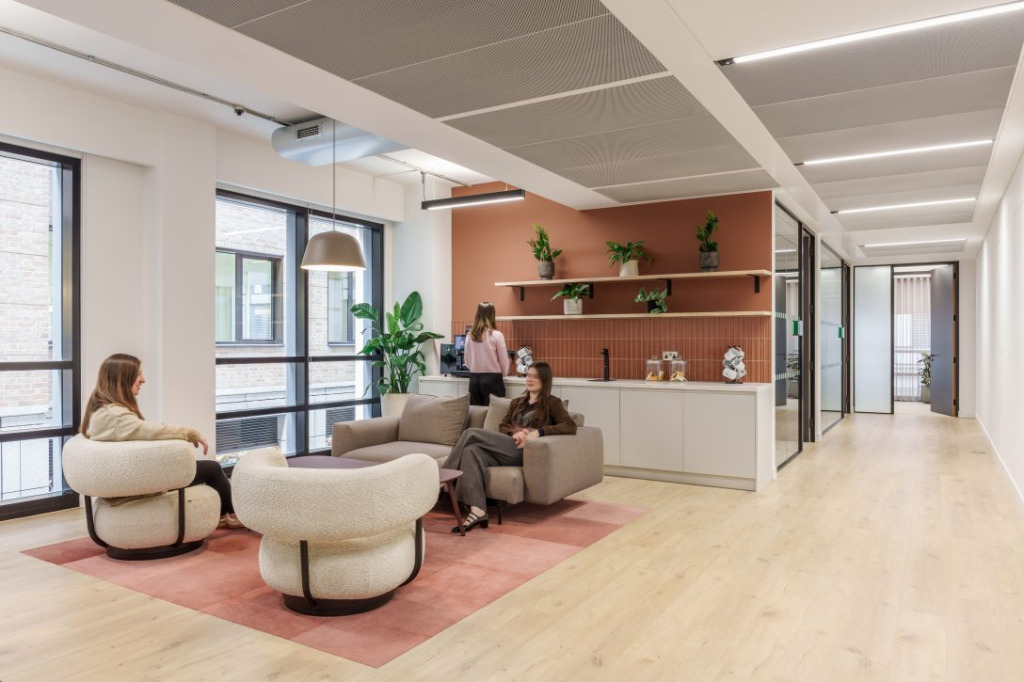
Familiar spaces are evolving in quietly telling ways. The tea point, for instance, has become a genuine social hub, with several now appearing across a single floor to spark the casual, unplanned conversations that structured meetings can’t replicate. As AI reshapes how people work, we’re seeing a growing appetite for the opposite: real human connection, individuality, and design that captures feeling, not just occupancy data. The organisations that get this right will treat data as a starting point, not an endpoint, for building workplaces people genuinely want to be in.
Getting financial services workplace design right isn’t just about creating a nicer place to work. It’s about building an environment that supports how your people actually operate, protects what needs protecting, and reflects the brand you’ve worked hard to build. If you’re exploring how your workspace could work harder for your teams, AIS’s workplace strategy expertise is a good place to start the conversation.

Speak
Get in touch
Contact usRelated insights
The Space Between
Creating Collaborative Spaces for Research and Innovation
Workplace Design Trends Shaping the Middle East
Sustainable Refurbishment for Local Authority Buildings
How to minimise disruption when refurbishing a school during term time

AIS is entering a new chapter
Time to Debrand?